Thursday, December 25, 2014

WATER and ITS MEANING


WATER and ITS MEANING
Post 113 --by Gautam Shah
 .
 Water is a great cleanser, it washes, and therefore heals and purifies. It softens so dissolves and penetrates everything. It nourishes and enlivens, and so satisfies. Our Earth, our body and all organisms contain 75-80% water, as the constituent matter.

Water is in dynamic equilibrium as its heat content is continuously balanced by transition from gas to liquid to gas at ambient temperatures. It is rarely pure, always has something, mainly salts, dissolved in it, varying its behaviour and the electrical properties. It has good cohesion and adhesion and capillary action. Water has a high dielectric constant, giving it an ability to make electrostatic bonds with other molecules, meaning it can eliminate the attraction of the opposite charges of the surrounding ions.

Air and Water are our two basic realities. The air begins and ends our conscious life, it is invisible and we realize its presence when we consciously breathe it. The encounters with water begin with embryonic fluid, and continue through the life. Water is omnipresent in our body and psyche.
The touch-feel of water by various limbs of the body, fingers, palm, feet, forehead, head, eyes or lips carries a sensorial and spiritual meaning. A wisp of moist air on a dry skin gives immense joy, a drop on the lisp revives a life, a sprinkle on forehead cools the fever, an anointment over head blesses the ethereal soul, and few driblets can quench thrust of a lifetime. A dip cleanses not just the body but the soul, and immersion reforms or baptize one forever, and a wudu or wash prepares you for the holy encounter.


Birth to death, all our activities are connected to water. Several water related processes such as sprinkling, anointing, partaking holy water, washing of body limbs, baths and dips, or full body immersions, are ordained in various faiths and regions. These processes also vary with terrain, climate or season, traditions, availability of process-conductor or priest, technology on hand, political compulsions and effects of other cultures.
All procreative fluids whether it is sperm, embryonic fluids, milk, or blood, are connected, detailed and metaphorically accepted with water. An unborn child gets a ‘shower’ of blessings, gifts, rice, etc. from friends or relatives as a social event or a religious ceremony. Post birth, the ceremonies are for real or ritualistic cleansing of the mother and child. A child passes through several such water related rituals till the age of prime-hood, such as baptism, tonsorial, ablutions, turmeric anointing baths for marriage, post death immersions and cooling of ashes.
 

Water by and changing its state, and while continuously flowing, sheds the impurities and remains pristine. It has little to offer beyond a deep satiation and the tactile perception. It has no colour of its own except endowed by the surroundings. It has no form but bubbles or ripples with air. It has no sound other than the rubbed by the surfaces. Pure water has no taste but of dissolved contents. Water is what we give it and expect of it
Rituals are interactions between humans and the environment, where God is made a witness. Water is the element that makes one aware of the environment, therefore the God. Water is embodied in rituals, lifestyles, practices, and our subliminal behaviour. The rituals turn the water holy or the holy water make for the ritual. The holy water is what one believes in. A flowing water separates the dissolved and suspended matter and so becomes pure and holy. The water also becomes worthy by ephemeral processes such as chants, Mantras and other conducts.
Processes that are good for humans are better for idols of Gods. In India idols are treated with water such as Abhisheka (bathing-offering of five nectars or Panch-amrutam made of water, milk, yogurt, ghee-clarified butter and honey), Prakshala (water bathing with or without milk), and Tarpana or Ardhya (an offering of water and other substances to all Gods, Planets and other spirits whenever a Mantra associated with it is recited).
 
Water is used for self cleansing or Aachaman. These include sprinkling, pouring out and partaking a small amount of water. Aachaman occurs during major religious ceremonies, day to day prayers, specific activities like before and after taking food, toilet, outdoor visit, visits to a low cast person’s place, etc. 
 .

Thursday, December 11, 2014

TOOLS and TECHNOLOGIES -1


Post 112 -by Gautam Shah
.

Humans developed a capacity to touch the digits of hand fingers with the thumb, along with the formation of hand tools. It substantially added to the capacity to coordinate tasks, power of observation and learning. First tools like sticks, extended the reach and handling ability. Small objects became target throwing tools. The wrist, palm, thumb and fingers, all in coordinated manipulation improved the human the task capacities.

Imaginative depiction of the Stone Age, by Viktor Vasnetsov

The oldest known tools date back to 26 00 000 years. For 20 00 000 years, rock chopper was the only tool for cutting and scrapping through the skin and sinews of the hunted animal, until hand axe, a superior version of the chopper appeared.

The chopper was just a fist-sized rock, chipped on one face, to form a roughly toothed but sharp edge. It was the only tool, till a superior tool the handled axe was devised. The stone edge of the handled axe was chipped all around, so was sharper and more effective than earlier chopper.

About 110,000 years back Neanderthal man began to use many different types of handled tools like axes, borers, knives and spears. In all these tools, the edges were heavily notched (due to chipping of the stone), but a toothed edge helped purposes such as carving, cutting and boring of materials like horn, bone, skins, wood, stones, etc. The edge stones were complimented by handles of wood and bones, tied with natural fibres, vines or guts.

 A fire-saw tool to create fire an object "sawed" against a piece of wood

Approximately 35000 years back, Cro-Magnon man devised newer tools. Burin, an engraving tool, was made from a sharp narrow flint blade for incising and burrowing. This made it possible to work the horn and bone into combs, needles, beads and such other small items. Tools similar to a burin were used for cleaning and shaving hides.

Primitive metal spade and two one-sided wooden metal-shod spades
Same tools were used for many different materials and equally varied work conditions. Specialized tools emerged as materials technology advanced from stone age, bronze age, to iron age. Complementary tools such as for gripping tools, holding the work pieces, sharpen used tools and measuring items were now produced. By Neolithic Period, about 7000 BC, ground tools replaced the chipped stone’s edges and points. Sharper ground tools were now used for agricultural operations, fuel conversion and for better shelter building. Tools increased the physical and remote (throw) reach, work and manipulative capacities of the body.


A tool is any physical item that can be used to conduct a task. Informally it also describes the related process. Tools have many designations such as handle, device, apparatus, vessel, holder and grip. A set of tools or process conducting facility is an equipment. Tool making, handling, task conducting, all make the realm of technology.

 >> Primitive spike harrow (Archaeological museum – Alanya, Turkey)

Tools were small handy things employed for a variety of jobs. Specialized utilities for specific work began to be formatted. The firsts were like the hearth, potter’s wheel, barrow, plough, cart, metal beating anvils, vessels and utensils, grain storage pits, and dwelling shells.

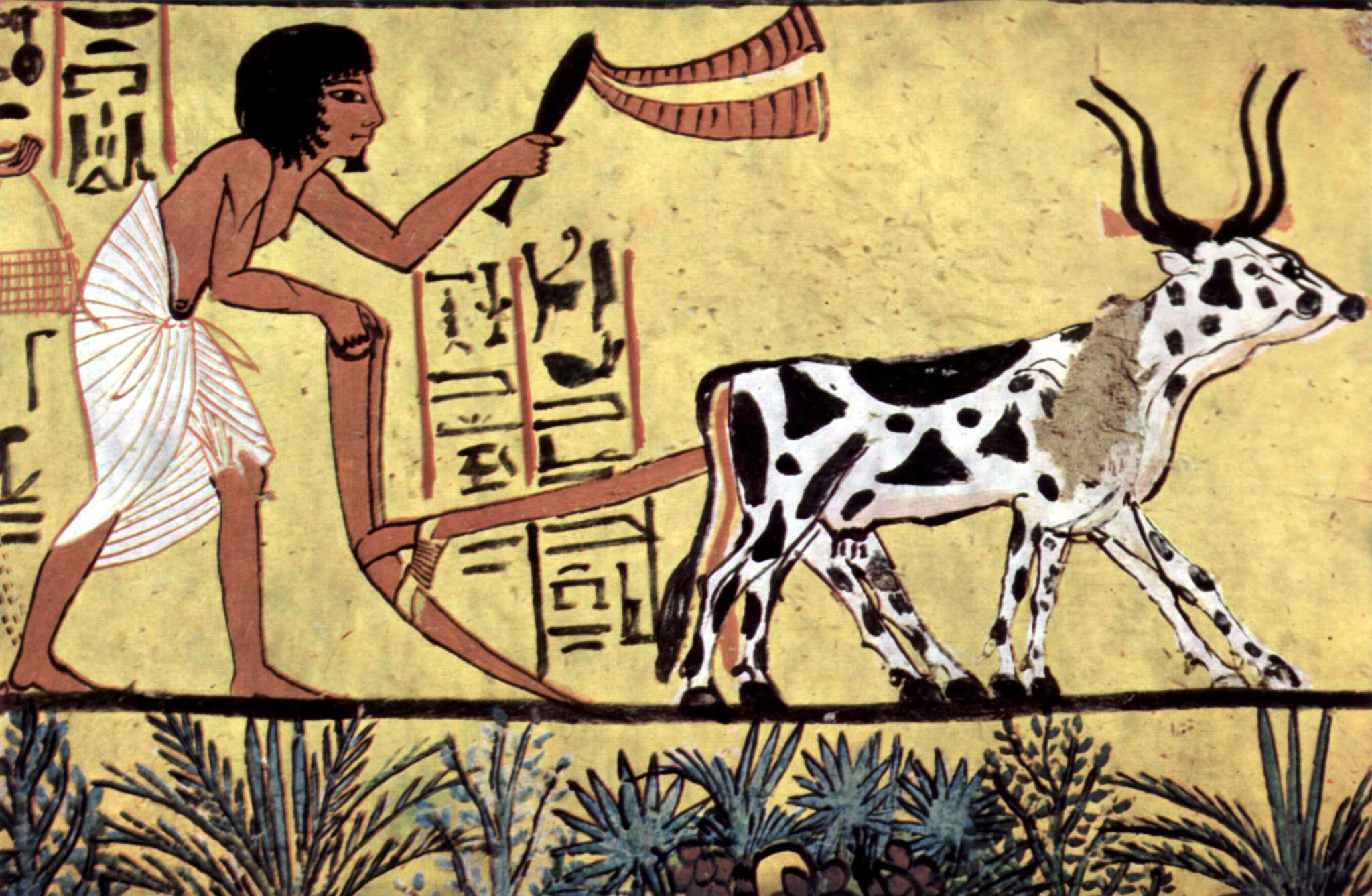
 Ox-drawn plough, Egypt, 1200BC.

First metal age tools were made about 5,000 years ago, by beating the naturally occurring copper nodules. People learned how to smelt copper alone, a millennium later, during the iron ages, though copper+tin alloy, the bronze was available. Iron offered many different options, making it possible to manufacture specialized tools for particular tasks.

 Boat-Building with adze 664-634 BC, Limestone, painted (194 x 270 mm). Brooklyn Museum.
Modern hand tools were developed in the period after 1500 BC. They are now generally considered in the following classes: percussive tools, which deliver blows (the axe, adz, and hammer); cutting, drilling, and abrading tools (the knife, awl, drill, saw, file, chisel, and plane); the screw-based tools (screwdrivers and wrenches); measuring tools (ruler, plumb line, level, square, compass, and chalk line); and accessory tools (the workbench, vice, tongs, and pliers).

Basic hand tools that occurred in the Stone Age were adze, auger, axe, knife, hammer, and chisel. During the Bronze Age, primitive forms of drill and saw were made. Medieval period gave the brace, tenon saw, and spoke-shave. In the Industrial Revolution period of the 18th and 19th C., hand tools were replaced by machine tools. Machine tools such as lathes, shapers, planers, grinders, saws, and milling, drilling, and boring machines became sophisticated with high degree of precision. During the early part of the 20th C., machine tools became more specialized and became part of assembly-line production systems. These specialized machine tools made it possible to produce economic and standardized products on a massive scale, by unskilled labour. In the past few decades highly versatile, accurate and micro tools with computer control, Automats and robotics, have been developed. It is now possible to go from a CAD programme to production, without the human interface. Robotics has reduced the idle time between processes, by conducting simultaneous operations in difficult to reach locations.
.


Friday, December 5, 2014

FINISHING TECHNIQUES for MATERIALS

FINISHING TECHNIQUES for MATERIALS
Post 111   by Gautam Shah ➔
.
 
Large number of surface finishes evolve during the manufacturing of materials. These are self finishes, so integral and permanent. Surface-finishes are also obtained by treating Natural materials and secondary processing of Manufactured materials. Assemblies of materials require modification of their surfaces, or a new finish to overcome-equalize the surface quality, and manage the disorder caused by the joints.

There are essentially four methods for creating Surface Finishes. To achieve a finish for sensorial or technical requirements, one or several of these methods, are used.
.

1 Techniques for surface finishing from the object itself.

2 Techniques for surface finishing with application of foreign materials.

3 Techniques of micro material deposition (same or foreign) for surface finishing.

4 Surface modification by secondary processing.
.

It can also be said that finishes are created by physical or chemical alteration of the surface, by adding new materials, or by removing a part of the original cover.

Many techniques of achieving surface finishes in use today are essentially the same as those employed in ancient times. These have been refined in terms of the tools used and rationalized in terms of procedures. Many processes are now highly mechanised saving time and energy, and some even are fully automatized, using robotics that allows faster, accurate and safer productions.

CUTTING: Cutting is the oldest of all techniques. Cutting is used for fast division of materials, and quicker removal of parts of materials (skinning, debarking, chopping, mining). Cutting is a crude, but primary technique of material finishing.

Wood cutting

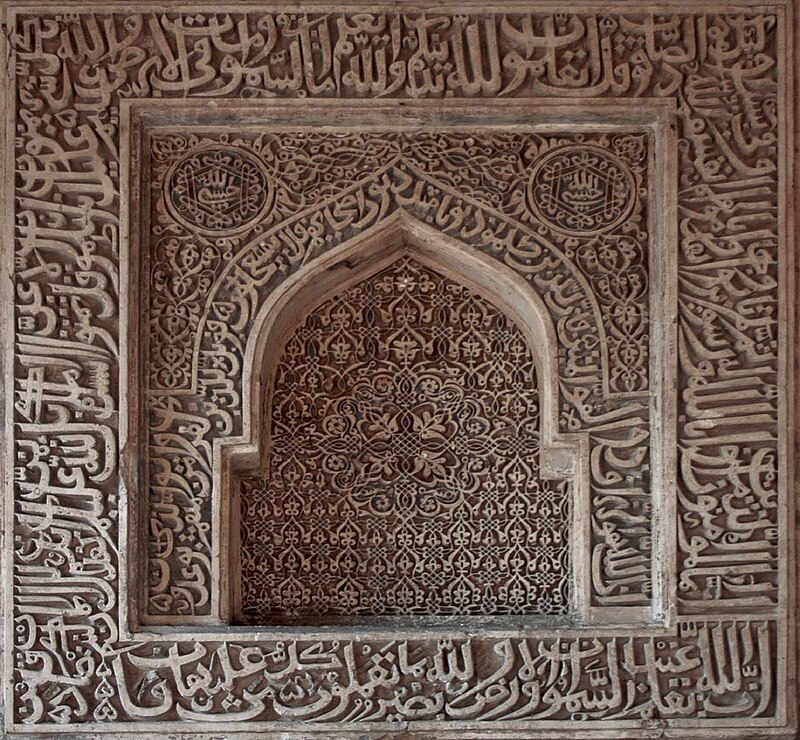
CARVING: Carving is a controlled cutting technique, requiring use of a chisel and occasionally pounding by a hammer. Carving is associated with fine but soft grain materials like ivory, horn, bones and wood. Carving is also done to pliable metals like copper, silver-based alloys, and also hard but fracture-able materials like stones.

Quran inscriptions on wall of Lodhi Garden Delhi

ENGRAVING: Engraving is a delicate and shallower material removal technique than carving, using a chisel or sharp pointed tools with hand pressure, or very light pounding of the hammer. Engraving is today done by fine rotary tools similar to the dentist’s pneumatic drill. A computer controlled, diamond bit engraving is now also done to ultra thin materials. In Intaglio, or Gravure, printing, the image to be printed is etched or incised into the surface of the printing plate or cylinder. Gramophone records have engraved and embossed grooves.
 Glass engraving

CHASING: For chasing, the material is depressed or displaced by a fine tool as dots, small length linear-strokes or in continuous linear patterns. Wet ceramic pieces, and plastered-surfaces are pattern rendered by chasing. Braille writing on a thick paper sheet is a form of chasing. Engraving and chasing techniques are frequently used to provide a matt finish, onto normally very glossy stainless steel surfaces. Chasing techniques are also used for relieving as well as introducing stresses at the surface section, allow moisture and heat transfer, and improve the ductility of the material.


 The Treasure of Sânnicolau Mare in chasing technique

EMBOSSING: Embossing introduces a texture through pounding, beating or by pressing of the surface. The pressure may be applied from one face or both faces of a sheet, locally as spots, or continuously under a plate or roller, creating repeat patterns or random designs. Pounding or beating, compacts the surface-sections of the material, and thereby increases its density and integrity. Embossing techniques are used to reduce the gloss by matting the surface. Embossing is done to increase the thickness bulk of very thin surface materials and make them apparently stiffer. Synthetic fabrics and fibres are emboss-deformed and permanently set (perma-set and texturizing) through heat or chemical treatment.


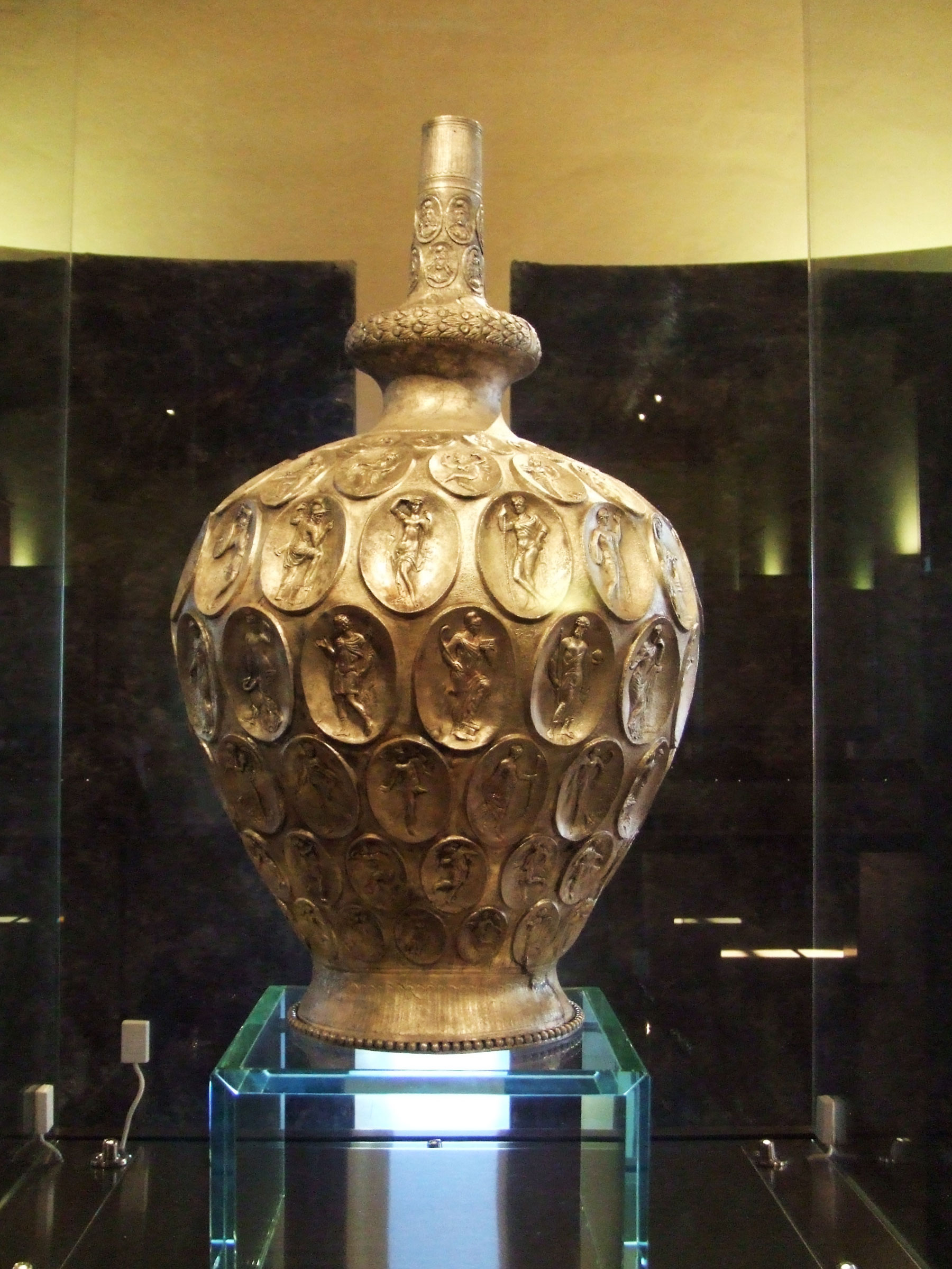
 Archaeological museum ( Piombino ). Amphore of Baratti ( 4th C AD ).


REPOUSSE: Repousse is a method of raising a design in relief from the reverse side. The design is first drawn on the surface of the metal and the motifs outlined with a tracer, which transfers the essential parts of the drawing to the back of the plate. The plate is then embedded face down in an asphalt block and the portions to be raised are hammered down into the soft asphalt. Next the plate is removed and re embedded with the face uppermost. The hammering is continued, this time forcing the background of the design into the asphalt. By a series of hammering and re-embedding, followed finally by chasing, the metal sheet attains the finished appearance. There are three essential types of tools used: -for tracing, -for bossing, -for chasing. Ornaments in relief are also produced by mechanical means. A thin, pliable sheet of metal is pressed into moulds, between set of dies, or over the stamps. Embossed utensils of copper and brass, statuettes of gods formed of thin silver and gold plates are very much part of every Indian house. Today Aluminium craft pieces are similarly embossed and black anodized.

Traditional Indian Brass and copper utensils have hammered finish on the outside. The same is often copied on aluminium utensils but reducing the strength due to ‘cold working’ of the metal. Leather and paper surfaces are rolled embossed to create textured patterns. Timber veneered surfaces are pressed for texture creation. Rendering of a wet plaster face by variety of pressing and chasing tools is very common. Chasing is very common with copper and brass pots.

MATTING AND ETCHING: These are mainly used for creating textured surfaces. Matting is generally a mechanical technique compared to etching where a chemically active substance is used. Mating and etching, are also achieved by metal removal processes (reversing the metal deposition by changing the cathode charge) in the final stage of plating. Parallel, crossed, irregular, concentric, circular and other geometric configurations are carved or embossed on the surface. Line and spacing between them are often less than 1/100 part of a millimetre, depending on the compactness of the material mass. Another method of surface decoration is to impress it with repeating patterns of hatched lines (used on precious metals), thus matting or breaking up areas to contrast with other areas left polished and reflective.

ETCHING: Etching is usually done by an active substance that will either eat away part of the surface or change its colour quality. Acid and alkali treatments also provide etched surfaces. Etching is also an artwork technique. Glass surfaces are etched with Hydrofluoric acid.

SURFACE LEVELLING: Surface levelling is a major field of surface finishing. Surfaces are levelled by chipping away very thin sections off the surface. The material must have layered formation (e.g. layered stones, wood, bamboo, cane) or fracturable or brittle constitution (e.g. stones). Surfaces are ground and polished for a levelling.

GRINDING: Grinding removes material from the surface to roughen a normally glossy surface like glass, or polishes a rough surface like stone. Grinding requires material of higher hardness than the surface material, and is done by rubbing down with a graded series of coarse to fine abrasives, such as Carborundum, sandstone, emery, pumice, sand, glass and diamond powders. Where a material constitution permits, very fine grinding may polish the surface. Grinding is a cutting operation in which each grit that comes in contact with the material cuts out a minute chip, or swarf. Grinding wheels usually consist of particles of a synthetic abrasive, such as silicon carbide or aluminium oxide, mixed with a vitrified or resinoid bonding material. Grinding can be coarse or fine, depending on the size of the grit used in the grinding wheel. Metal and glass can be ground to a mirror finish and an accuracy of 0.0000025 cm.

Metal Grinding

POLISHING, HONING, LAPPING, BUFFING: Polishing uses extremely fine abrasive substances, such as jewellers rouge, Tripoli, whiting, putty powder and emery dust to rub or burnish an extremely smooth and brilliant finish on the surface of a material. The polishing materials are coated on the surface of cloth, felt, leather, rubber pr polymer wheels or as belts. Metal surfaces are levelled and finished by honing and lapping. Honing removes less than 0.0125 millimetres of material from the surface to eliminate micro scratches and machine marks from ground machine parts. It is done with bonded abrasive sticks or stones that are mounted in a honing head. Lapping is a process in which a soft cloth (wool, linen and chamois-leather) impregnated with abrasive pastes (rubbing compounds), is rubbed against the surface of a work-piece. Honing and lapping, are essentially metal finishing techniques.

BUFFING is a term used for polishing of metals. Buffing is done with polishing compounds and brushes of various shapes, and abrading materials, like: (animal hair, synthetic fibres, plant fibres -coir), flex, wool and leather. Barber polishing the razor on a leather stripe is a buffing process that levels out small nicks on the blade. Utensils are buffed for a polished surface.

LAPPING is used to produce a high-quality surface finish or to finish a workpiece within close size limits. Dimensional tolerances of 0.00005 millimetres can be achieved in the hand or machine lapping of precision parts such as gauges or gauge blocks.

SHAVING AND SPLITTING: Shaving is done to remove material’s components such as outward hair or fibres, layers, etc. Leather surfaces are shaved for thinning and to remove the surface hair. Leathers are also surface split to separate leather suitable for uppers and soles. The palm leaves are shaved to remove the stems and make them smoother for writing. Tree-barks are removed by axes and choppers to retard insect attack and increase moisture removal. Timbers are re-cut or planned with finer tools to achieve a smoother surface. Timbers are split very finely to create veneers. Wood planning is also a shaving technique. Carpets and rugs require close shearing by scissors to shave of protruding fibres.

 
SINGEING: singeing is a controlled burning (or a heat treatment) at the surface section to remove part of the material and to change the colour or texture properties of the surface. Singeing is both a process of surface finish and surface cleaning. Most of the organic materials can be surface-treated directly with fire or indirectly with high heat to achieve a singed or ironed effect. Textiles, paper, leather, leaves, wood, etc. are some materials that can be burnished. High temperature singeing removes the surface fibres and hair, and chars or burns (sinter) the top part of the surface, creating a burnt colour + texture effect. Textiles are Ironed, for de creasing or perma-set, or creased with pressurized heat treatment. Synthetics or composite textiles are selectively or locally singed to fuse the fibres or filaments, to create texturized effects, and also alter the transparency, opacity, etc. Wood surfaces on flame treatment attain a dehydrated or shrivelled-shrunk surface, similar to an old wood. Metal surfaces also singed not only to harden or anneal the top surface but to burn the oily residues, dehydrate, and descale the surface. Singed metal surfaces often attain peculiar colour and pattern effects.
.


Thursday, November 27, 2014

CREATIVE COMPOSITION

Post 110 - by Gautam Shah
.
 We express about things, ideas, dreams, experiences, concepts; to re-enact, record or communicate. The re-enaction helps to reinforce the experience of a happening, and recover the missing sets of information. Recording helps to organize and condense the information for posterity. Communication imparts information to someone or secures a reaction.


The focus of the re-enactment is what one strongly feels, desires, or believes, and with that entire experience enlivened, justified or confirmed. Events occur in spatial context and have time sequencing, but for re-enactment, it is the personal relevance that becomes the force-de-majeure. The links between spatial or temporal segments are not amenable to any logic and so remain ethereal.
The recording media (paper, tape, film) is an estate that must be used carefully. A record is created for its retrieval in some other time and space, by own-self or someone else and in part or as a whole. These, needs some order and frugality. So records are better organized then personalized enactments.


Communication occurs through writing, oral and gestural deliveries and through abstract medium of graphics. It is an expression for a target ‘audience’. The author must be proficient in the subject and have some knowledge about the target audience. The contents are sequenced, with time as the operative element. Oral or gestural deliveries are sequenced in time so are lineal. Writings can have non-lineal arrangement provided it is aided indexing. Graphical formats are impressionistic, rely on the holistic effect. 

Such spatial ordering is used to highlight or amplify certain sections as well as to demarcate sections. Other spatial formations are based on some value judgement system. Database management presentations use such value-based derivations. Spatial formations such as tables, matrices, etc. are used for data management in spreadsheets.
 Flaubert's heavily edited page of his manuscript for Un CÅ“ur simple

Creative Compositions use many of these techniques:
Time and Space ordering:
The contents are sequenced, with time as the operative element. The time is apparent in sequencing of events, time related measurable changes, accelerations and deceleration and for cause-effect presentations.
In speeches pause is an important time section for concepts to sink in, allow the audience to respond (clapping, thumping or noise to die down), or enhance the delivery of next expression. Audio-video presentations are synchronized to beats, or tempo-pitch of the delivery. Background noise and music are scaled to the nature of contents. 


Emphasis by Condensation and Elaboration:
The emphasis in compositions occurs by condensation and occasionally by elaboration of the subject matter. Emphasis is often created by intentional de-emphasis. Obvious details, concepts, ideas, conclusions are not put forward at the nominal time and space, but are placed at the end, or the audience is allowed to draw its own inferences.
The condensation and elaboration are employed to colour a document as a personal style statement.

Condensation eliminates all unnecessary and less necessary contents, and thereby increase the clarity, reduce the expression size, delivery time, perception effort, etc. Condensation is also done by use of abbreviations and symbols that replace large units of contents. These include idioms, proverbs, metaphors, and signs. Condensation is often used to restrict the access to a specific class of audience, like magicians’ instructions.

Elaboration is achieved by augmenting the context of difficult to understand concepts, events, situations, or objects. It is also done by using the same word in different context, and using similar words (synonyms and antonyms from a thesaurus) to redefine the meaning. Multiple explanations help amplify content. Elaboration is achieved by inclusion of anecdotes, couplets, quotations, footnotes, end notes, and other sensorial effects.

Bridging and Linking:

The contents are bridged to create a seamless statement or a larger concept. The most common bridging is through time and space organization of the contents. The links to other documents (e.g. hyper-links, bibliographies, index) are such reference bridges. Recorded contents are classified according to the nature of content, name of the author, date of publication, size and form of the document. Such classification identifiers also provide associations. A well bridged or cited content vouches its authenticity through circumstantial referencing. Contents are also bridged using conjunctions. Words like and, if, or, when, then, whereas, therefore, etc. connect clauses or sentences. Bullets, numbered lists, also bridge sub topics.
 

Separating and Isolating:
The contents are separated or isolated, by spacing (white spaces, pauses, start of new paragraph, section or a chapter), and by tabulation (bullet marking, numbering, hyphenating, bracketing), to highlight or categorise the sub-topics. Separation in writing is achieved by commas, semicolons, brackets, or other interludes (gutter spaces in newspaper columns). In recordings a null space is provided for the machine to recognize the end of one section and the beginning of next one. By isolating the contents it becomes easier to link each such section distinctly.

Abstraction:
The contents are abstracted by removing all less important information, time slots and space gaps. The expression language in Internet chat rooms shows the nature of abstraction spreading across the world. Common words are written by eliminating vowels and are denoted by their phonemes. Symbols and metaphors are also used to squeeze the contents. Vedic mantras represent knowledge in a very condensed form to easily remember it (‘Shrut Gyan’ -knowledge that is heard). However, such condensation allows for different interpretation of the contents.

Marking
Contents are marked to enhance (bold facing, underlining, Italics, large size type faces) their presence. The contents are delivered louder, faster or slower, brighter, repeatedly, and in metres (musical, couplets with rhymes) for the same effect.

Order of contents
An expression can begin as an inquiry into a seemingly un-ordered realm, and conclude with a definitive proposition. Other way round, the expression can state a hypothesis or belief, and proceed to present the evidence in support or against it. The third method is hybrid, as it starts by analyzing a happening with all the cause-effect contexts.

 Support from other media

Emphasis by support from other media is exploited to not only enhance the contents, but also its presentation. In writing and print media some of the topographical tools used are: underlining, bold printing, fonts' sizes, colours of font and background, font styles (plain, italics, small caps, with serif, sans serif, etc.) Other graphical tools include insertion of graphs, charts, illustrations, etc. within the document content. Multi media presentations have more than one format like static pictures, movies, 3D effects, animations, sound clips, body vibratory systems, ‘olfactory and taste’ supplement systems.
In oration a speaker boosts the delivery with body gestures, repetition of words or sentences, pitch variation of voice, use of rhymes, rhythmic, metre oration, poetical recitation, etc. The information gets registered easily when supported by visuals such as tables, charts and graphs, picture slides, movie or video clips, animation. Learning frames or interludes are subtly included to lodge the contents easily into the minds.

●  By Titling (Naming)
One of the best way of focussing (by declaration) the content is to provide a title to it. A title as created by the author is more truthful but is not accepted by the reader or audience, as their intentions of accessing need not match the author’s perceptions. Storage systems create own titles to facilitate access by their users’ needs. Titles have limitations of size. This is overcome by including long titles or list of keywords or summary or precis.
.

Saturday, November 22, 2014

LANGUAGE EXPRESSION and SOUND PERCEPTION


Post 109 - by Gautam Shah
.
A language is defined in many different ways. Some have defined it to be a string or combination of vocal sounds by which communication occurs. Others have called it to be an expression of ideas that combines the contents and sounds. In both the definitions, Expression and communication are common, but in the first definition the association of sound is considered an essential component. Contrary to it, deaf and dumb are able to communicate and express themselves. A language as an expression has either vocal or a graphical representation.

Within a community a language is the basis of expression and perception of information. It is the working system of communication matured over a period of time. In Gujarat, India, it is said that at every 30-km distance there is a noticeable variation in phonemes. This is due to effect of the local flora, fauna, terrain features, visitations by outsiders, and in recent times due to the media. Communities have unique spatial conditions such as the seashore, riverside, flat desert or a valley, providing different contexts for sound reverberation (response) system. Outsiders like street hawkers, and administrative officers, strongly impact the local speech style. People over a period modulate their sound delivery accordingly. Such impressions are stronger in close-knit societies. Immigrants pick up accents of the adopted place.

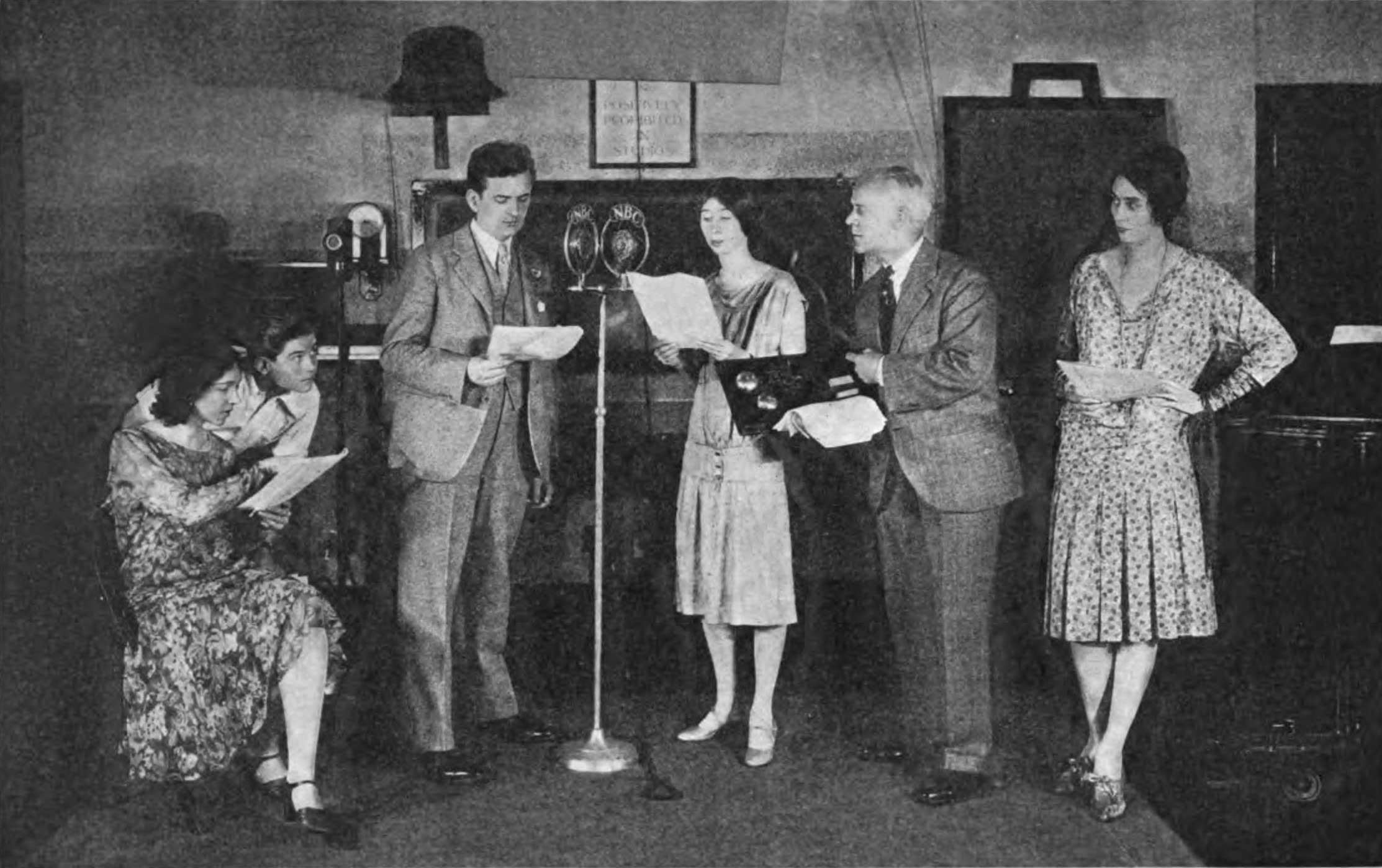
 The media, telephones, radio, television, and stage performers have very strong influence, overriding all territorial peculiarities. Their styles have an acceptance due to sleek presentation and frequent exposure. Non-local teachers do the same. The delivery technology used by the media affects the ‘sound’ quality, one tries to emulate. Telephones transmit sound within a narrow range of frequency to economize on band widths. Public speakers exploit the microphone-speaker system to deliver very faint sounds with sufficient loudness. Television broadcasts from extra ordinary large volume studio spaces rarely reflect the spatial character. Films and TV serials shot outdoors, on sets or in real built spaces never differentiate between the space volume, surroundings’ surfaces, or the background noises. People perceive the effectiveness (clarity, improvisations, improvisations, etc.) of the delivered product as the ideal manner, and replay the effects, but minus the production shortcomings or gimmicks.

Doctored Sounds of Media

Across communities, different meanings are assigned to different sounds and written scripts, and often words and groups of words have different meaning. Expression in one language is difficult to transport truthfully into another language, phonetically or literally.
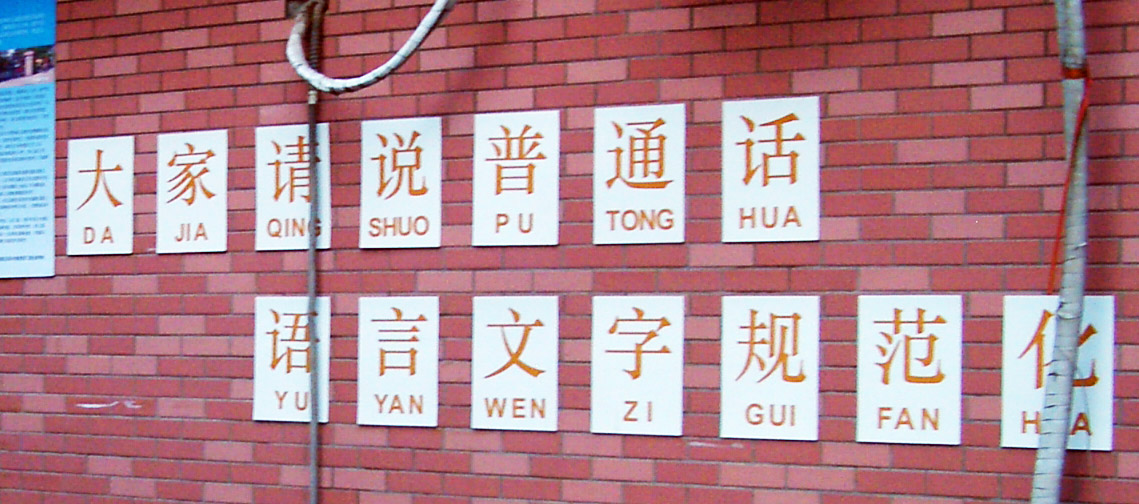
A school slogan asking elementary students to speak Putonghua is annotated with pinyin, but without tonal marks.
Large number of words in a language have no phonetic bearing, because our experiences are not directly related to sounds. The sound is believed to be the basis of human language.
In ancient times preparing a manuscript was a hardy task. The Expert who dictated was rarely capable of writing or scripting it graphically (calligraphy). Copies of the manuscripts were made by other people, often in different time and space. The original document reasonably matched the phonetic impressions, which was diffused in copies of the copies. Every copy maker had own calligraphic style and smartness of editing, and produced a slightly modified version. In India, several manuscripts of the same composition are found at different places, collating them into a master-authentic version is nearly impossible. Popular old songs have varied forms of lyrics, because every singer improvises the phonemes.
Atlantean language is a constructed language created by Marc Okrand for Disney's film Atlantis The Lost Empire. Wikipedia image by DrNegative
In India Veda and other ancient literature were originally Shrut Gyan, knowledge propagated by listening and remembering. As a result all compositions were recite-able, set in metres. Sections of Shloka or stanza were phonetically of same duration in time. However, when these came to be written down, the temporal (time) equalization was not being reflected in written format. The signs (alphabet) and calligraphy, together created stanzas of spatially unequal lengths. What was sensible in speaking or reciting had acute graphical or representational problems. This was solved by combining several words (called Sandhi). Now the written and recited stanza had same time-space relationship. Very often new enlarged and shortened words devised, or shorter synonymous words were employed. In many languages the scripted and pronounced words have anomalies.

Vishnu Shahasranam

The meaning of a sentence comprises in the meanings of the words it contains and the structural or grammatical meaning carried by the sentence itself. Sentences containing exactly the same words, carry different meaning, because the order of placement of words distinguishes -conventionally called subject : object and meaning. However, in Sanskrit the object-subject relationship is not dependent on the sequence of the occurrence.
The formal resources of any language for making distinctions in the structural meanings of sentences are limited by two things: the linear (time) dimension of speaking and the limited memory capacity of the human brain. Writing exactly copies the time stream of speech. Writing is partially relieved of memory capacities by the permanence of visual clues. Written texts are almost entirely ‘divorced from oral pronunciation, sentence length and sentence complexity can be carried to extremes, as is being observed in some legal and legislative documents that are virtually unintelligible if read aloud‘.
.


BERNARDO BELLOTTO

  BERNARDO BELLOTTO Post -376 SUNDAY Feature on ART of Architecture -by Gautam Shah BERNARDO BELLOTTO (1720-1780) was born in Venice (d...