Thursday, January 30, 2014

THE CRAFT OF WALL PAINTING (Palaeolithic)

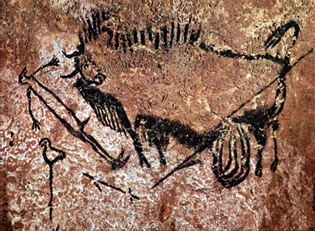
Altamira Bison

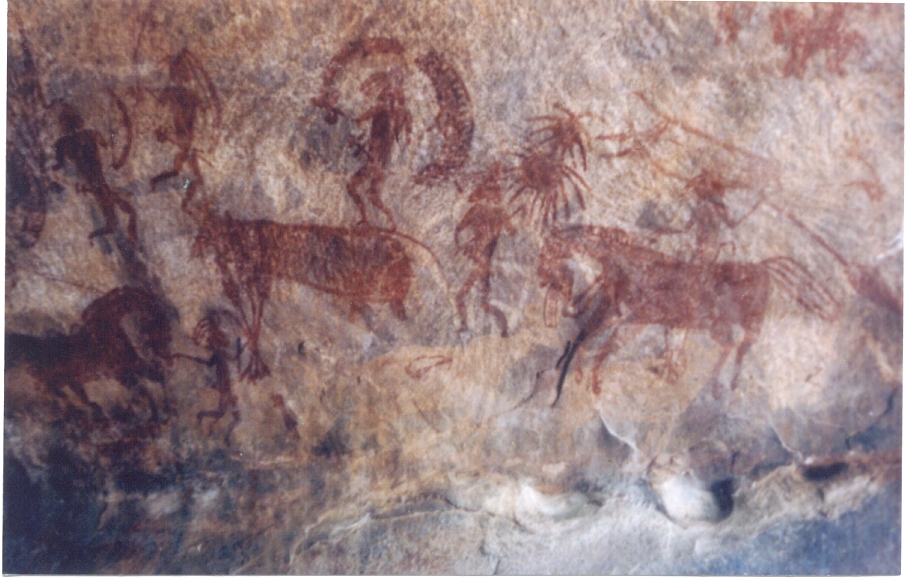
The wall paintings (upper palaeolithic era) began some 40000 to 60000 BC, as a medium of expression -a ‘story’ telling exploit. It was not a decorative art for a place. The paintings were in deep caves as well as open sites. Bhimbetka, India, site shows human occupation for more than 100,000 years, but earliest paintings on the cave walls here date back just 30,000 years ago.

Bhimbetka rock paintng

  • Upper Palaeolithic period began roughly around 40,000/60000 years ago and lasted through the Pleistocene ice age, which is believed to have occurred near 8,000 B.C. This period was marked by the rise of Homo sapiens and their ever-developing ability to create tools and weapons.

The cave sites were difficult to access but were perhaps special and visited by several generations.  The caves were deep and dark that artists worked with lamps and torch lights. The paintings were made on walls, ceilings and even floors. Many of the locations and surfaces were acutely irregular. Artists had to work in squatting lying position or use elaborate scaffolding to reach the heights. The scale of the job was stupendous. Deep cave paintings have survived whereas open location paintings have generally been destroyed.

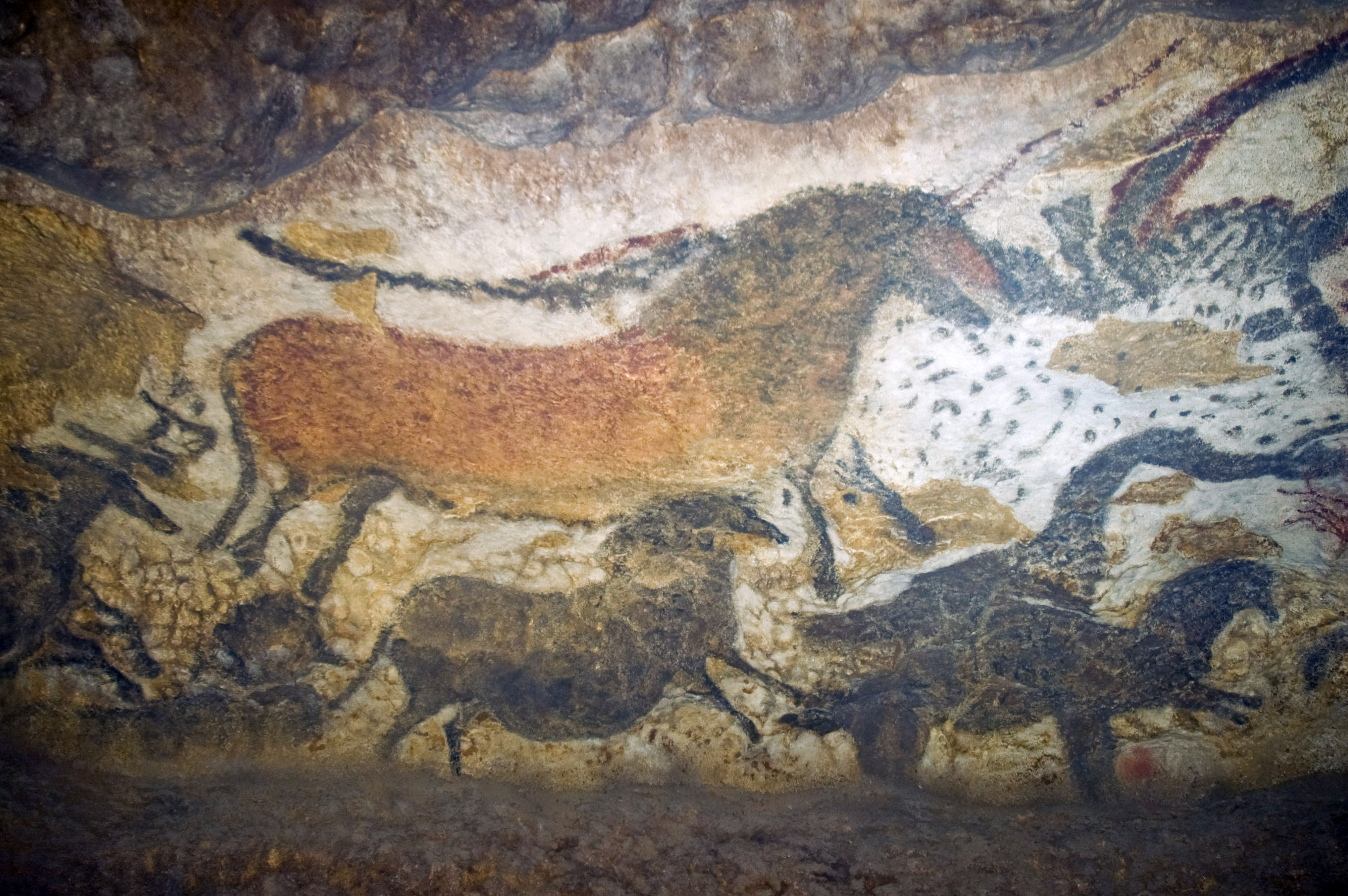
  • ‘At Bernifal in the Dordogne, the mammoths are painted 20 feet up. Some of the bulls at Lascaux are more than 20 feet long. The big cave vault at Lascaux, known as the Picture Gallery, is more than 100 feet long and 35 feet wide.’

The cave art consists of simple impromptu works as well as grand executions, first type executed by amateurs or apprentices, and the second by masters.  To sustain projects of such scale the master artists were helped by a retinue of assistants and the community. The assistants helped in erecting scaffolding, preparing the surface to be painted, mixing colours, devising brushes and other colour application tools, feeding animal fats to lighting torches, provisioning food and water.
http://upload.wikimedia.org/wikipedia/commons/4/40/Lascaux_II.jpg
The cave artists have shown very high degree of professionalism. The compositions, understanding of the animals’ anatomical details, animals’ form, dynamism and movement, all represent a keen sense of observation, experience and discipline. The limited choice of colours has been overcome by the masterly expression of form. There is consistent economy of line. The textural and tonal qualities do not represent the light and shade, yet suggest the depth through colour differentiation (recognizing the ‘grey tone value’). At places existing substrate texture has been exploited. The scale and distribution of objects within a composition do not follow a visual proportion system yet prioritize the elements of the story.

http://upload.wikimedia.org/wikipedia/commons/6/65/Lascaux_01.jpg
Wall painting began as a line drawing. Lines were frequently scrapped through a sharp edged tool. The etched lines perhaps helped in retaining the charcoal or soft stones rubbings. Such art works, as the first responses were impressed on whatever interior or exterior surfaces that were available. However, it was realized that more permanent work can only be created in a protected space. The caves space and its environment stimulated a spiritual experience for the portrayal. The spaces must have been favoured by several generations, as some of the paintings have been modified repeatedly over thousands of years. The earliest works are refined compared to later works or modifications.

There is nothing to suggest that the art was a setting of a ceremony. There is no depiction of a sacrifice, or a master of ceremonies  like a priest, sorcerer or a witch-doctor. The paintings also have no images of the surrounding terrain or the vegetation of the time.

http://upload.wikimedia.org/wikipedia/commons/2/2f/20%2C000_Year_Old_Cave_Paintings_Hyena.gif
The palaeolithic wall art consists of three main categories of subjects: animals, humans and signs (abstract or unexplained). The animal figures are the most detailed and naturalistic representations, but drawings of humans are rare and perfunctory. ‘In the case of Chauvet, predatory or dangerous animals dominate, while in Lascaux the main representations are of large herbivorous mammals’. At caves across various geographic locations the animals include:  woolly rhinoceros, lions, bison, horses, aurochs, bears, reindeer, wisent, and giant deer and hyenas. At places species which were then extinct (as per the time dating technology), are also painted. Some of the most common species such as the reindeer do not find any representation, though bones have been found in the cave. The wall art also includes prints of spray painted hands, with abstract interconnecting lines.


MATERIALS and TECHNIQUES

http://upload.wikimedia.org/wikipedia/commons/0/07/Lascaux2.jpg
Wall art of upper Palaeolithic age in the early phase did not have any surface preparation except scrubbing off the loose particles and dust.  Selected surfaces were away from flowing or leaching water. Early phase drawings were done in line work with charcoal, but compared to this the carbon black, a deposit over an animal fat burning lamp had better binding and colour saturation. Lines were also scratched or etched by a sharp tool and done over with a black colour. Scratching the surface also ensured better colour retention. Later renderings (filling up the colour) with red ochre (Iron oxide from Haematite) and black was done. In the later phase (25000/20000 BC) other colours such as yellow and brown were added to the palette.

In the initial phase dry colours were rubbed over the surface. In the later phase colours were ground with water and additives like blood, urine, eggs  and animal fats. The additives improved the bonding, increased the viscosity (to prevent run-off the surface) and reduced the drying time (allowing application and rendering effects). Learning also included: how to prepare intermediate shades (orange and browns), prevent algae like growth, avoid colours that fade over an age and moisture bleeding of colours and additives. Colours were mixed Calcium containing water or nodules to improve fixing.

http://upload.wikimedia.org/wikipedia/en/6/6a/GuaTewet_tree_of_life-LHFage.jpg

The colours were ground by rubbing them over a rough surface and through pestles and mortars. At Lascaux, some 158 different mineral fragments were found. Shells of barnacles and human skulls were used as containers for ground pigment pastes. Colour was applied by brushes, twigs and fingers. Colours were also put on by spraying through mouth and blow pipes made from bird bones, and by daubing with hands, fibrous pads and soft skins. Colours were sprayed over hands as the stencils to perhaps mark the participation or visitation.

.

This the Fourth article in the series "Surface Finishes -COATINGS". Earlier Three articles were published during Sept 2013. Many more to come ......

.

Sunday, January 26, 2014

PARTITION WALLS and Buildings


A partition wall is generally a non load-bearing element except in an emergency where it may temporarily carry a load. A partition wall could be an internal unit designed to divide spaces to form separate rooms, circulation spaces and service ducts. External partition walls enclose a space, provide a barricade, be a decorative surface appendage, or provide massive effect to linear elements like columns or slab edges. Partition walls do many other things besides partitioning so become integrated systems. Partition systems are full height touching both floor and ceiling or part height, off either the floor or ceiling. Free from floor partitions are used in wet or rough areas and where floor cleaning is frequent (such as toilets, dressing booths, shower stalls). Open office partitions, if free from the floor allow low level circulation of air. Upper level free partitions are used for ventilation and visual openness at ceiling level. Partition systems are both, fixed or relocatable. Partitions often act as a barricade.

Partition systems can be categorized in following manners:

Frame and cover systems: This consists of a frame matrix or grid supported all around, and covered by a sheet material. Frame grids are designed considering the architectural character, the framing material’s commercial sizes or sheeting material’s size, but always accommodating the joints over the frame section. The sheeting material does not reveal any part of the frame, but a well-designed system could through the joint lines reveal the character of the frame matrix. Such systems could be a single side, provided the non-sheeted side is unimportant or the frame matrix is well modulated. Frames in such partitions need to have lateral stability (usually the height) or sideways stability depending on the distance negotiated between structural elements like wall, column or another partition at an angle. Frame and cover systems are easy to build (but not necessarily economic) yet government departments lacking imagination have it. These partition systems need to be seam closed at open ends, otherwise sheet material come off.

Materials for framing are wood and very rarely mild steel or aluminum sections. For permanent partitions often non planned -raw timbers are used. For marriage pandals the vertical framing is of thin wood logs (bullies) and bamboo for the horizontal. Sheet materials for covering are plywood, hardboard, MDF, particle boards, chip boards, metal’s plain, composites, corrugated or embossed sheets, cement fiber sheets, paper boards, glass, cellophane, plastics, composites, fabrics, woven mats, palm leaves and reeds. 

Stud and in-fill systems: These partition systems have studs (vertical units) fixed to top and bottom (usually floor and ceiling or beam bottom) members of the structure. Studs are generally independent of each other, but sometimes with one or more horizontal ‘spacer or tie’ members. The studs are stabilized by the in-fill material along the direction of partition, but need to have stability of their own in cross direction. This results in rectangular sections for the stud. The studs are spaced according to the width of in-fill material or spaced to provide a stable system. Studs are made visible on both side by fixing the in-fill material at mid section. Studs are less dominant where the in-fill materials are fixed with one side as flushed surface. Studs are also totally covered by a running sheeting material as in the frame and cover system of partitions. 

Stud materials include sawn wood sections, wood logs, Mild steel and aluminium extruded, folded and fabricated sections, PVC extruded sections, stone pillars, pre-cast RCC units, laterally placed sections of in-fill materials, and taut ropes of steel or fibres. In-fill materials could be like the stretched thin wall membranes, fabrics, plastics, composites, pliable materials like metal sheets, or stiff materials like plywood, block board, MDF, wood composite boards, stones, glass, timber planks and grills.

Panel Unit system: This consists of small elemental panel units which are placed within or over a frame system. The panels are positioned edge to edge, either fixed to the top and bottom, or fixed edge to edge. Panels are preformed or site formed. Panels are composite in construction, dimensionally modulated and multi-functional. The panel may be with plane seams on the edges with or without a bead (cover) section or have tongue+groove joints. Panel units have butt or snap-on or hinge joint systems on the edges. Panel systems are used for creating ‘open office plan’ layouts, exhibition display systems, information kiosks, etc.. Panel units are usually self supporting systems, through layout geometry (hexagonal, triangular or right angle), but in very extensive partitioning, frame and panel systems are formed. The panels are also fixed directly to the floor and to the ceiling or beam bottom through channel or stud receptacles.

Panels are multi layered sandwich composites with a hollowed inner core, foamed, expanded, or lightweight in-fill materials. Recommended dimensional modulation as per ISO is 100 mm. Top finishes of many varieties are available like: fabric, paper, wood, plastics, stainless steel, glass, and painted, screens printed, embossed or coated. 

Folding and sliding systems: Folding partitions consists of modulated panels, which fold together or a construction of linear members that collapse (such as the elevator doors). Sometimes the panels are demountable, so can be removed completely and stored separately (such as the storm shutters). Sliding partitions are mounted on a track or a channel, at top, bottom or both. A combined sliding and folding partition have sections of small width. Vertical Venetians or striped soft panel partitions are used in warehouses with forklift trucks and at the mouth of moving assembly lines.

Demountable partitions: These have a characteristic lightness in weight. Removal and subsequent relocation of a demountable partition do not materially affect the adjoining structures. Demountable partitions can be moved around to suit the changing user demands. In buildings for Industrial, Commercial, Health and Educational purposes changes in work processes, plants and equipments, economic, social and political relevance occur very rapidly, and demountable partition systems of walls provide the required flexibility. 

Essential characteristics of demountable partition walls are: light weightiness, manageable size (transport, carriage through a stair and elevators), seamed but mating edges, forming and siting geometry, interlocking mechanisms, other fixing devices, cores for removal and reinstatement of services (electrical, communication), changeable surfaces, repairability, dimensional adjustability. 

Demountability: Cost, performance and appearance of a partition system are affected by the option of demountability. The complexity of the demounting and remounting the partition installation and accompanying alterations in the surroundings require careful considerations. For example regular adaptation to be handled by the user require the ease of sliding or folding mechanism. Once in a while changes can be carried out by maintenance staff, but allow the use of a more sophisticated system. Quality of sound and thermal insulation are significantly poor on very easy to demount partitions. Lighting and other services in demountable systems are basic only and involve higher costs but complex detailing and pre planning. 


Friday, January 24, 2014

WALLS and Buildings

A wall is a barrier system, used for dividing or enclosing a space, usually in a position that is perpendicular to the gravity, but not necessarily. A wall can also be defined as a planner structure, generally vertical, with a proportionately narrow thickness in comparison to its height and length. A wall is required to resist besides its own weight -the self load, the dead load of super structures, and live loads of people and their objects. In addition to these loads a wall is required to transmit lateral forces from arches, vaults, and side pressures like wind, vibrations and earthquakes. Loads are transmitted along its section and often across the section of the wall. However, beyond the gravitational zone, in outer space structures, super imposed loads on the ‘wall’ are converted into stresses and ultimately in some form of kinetic energy, so an equilibrium must to be maintained. Loads on walls primarily occur as super imposed loads, and as reactions from the supporting elements. Loads are concentrated at a point, or distributed. Concentrated loads induce local stresses and failures, and under excessive distributed loads the wall fails locally at its weakest section or gets crushed or deformed wholly depending on the homogeneity.

Wall loads ultimately accumulate at a point within the section that is closest to the earth. (often requiring heavier bearing area) and are transmitted ultimately to another structural member or base (foundation).

When a wall has width equal to or less than its length, it becomes a column and loses its meaning. Moreover, a wall that has a height equal or less than its width, remains an infill course or layer only. Walls without any external down bearing loads are called partition walls.

A wall, due to its mass, specific gravity, constitution, shape, size, extent, position, surroundings, is capable of absorbing, reflecting, refracting the incident energy like heat, light, sound, vibration etc.

Walls also carry loads as side thrusts across the section. Such loads include wind and sound (sonar) pressures, retained liquids or gases, pressures caused by a mass of loose particles such as grains, sand, soil etc., air displacement pressures of blasts, eddy currents, tides, waves, etc. Additional depth throughout or intermittent supports are required in such walls along the length and height.

A wall carrying only side thrust is called a retaining wall. A wall which carries the load of upper structure (bridge) and also retains earth is an abutment wall. A gravity wall resists the side thrust of retained material by its dead weight. Gravity walls primarily have a trapezoidal section, with wider part forming the base. Cantilever retaining walls have ‘L’ or inverted ‘T’ section. A buttressed wall has additional intermittent strengthening mass, on the open face, to buttress the wall, whereas a counter-fort wall has a similar system (in tension) on the inside or loading face.

Walls with very thin width are called membranes. Membranes structures are formed by stretching a thin and pliable material along its plane, into structural forms. Membranes ‘walls’ or surfaces can carry well-distributed loads, but are incapable of taking any pointed loads. Boat sail and circus tents are examples of membrane structures. When the wall material is hard, homogeneous and rigid, it is called a plate. A plate wall functions like a wall, as in the case of folded plate structure forming side walls (Tagore Hall, Ahmedabad, India).

Openings like doors and windows weaken a wall. Logically openings at lower level have to be fewer and with restricted widths, because lintels bear greater loads. However, openings are placed one above the other so as to leave uninterrupted vertical wall masses to transfer loads directly to the ground.


Walls are likely to be less stable if:
  • are designed as partition walls,
  • do not touch any rigid or secured member on either side ends,
  • do not intermittently turn around or have additional wide stiffening members
  • are free at the top that is do not touch a structural member
  • are very tall for their sectional width
  • face high temperature difference across the faces
  • have a centre of gravity very high or out of the section
  • stand on a vibratory, compressible or unstable member or earth surface
  • are not consistently homogeneous
  • have not been designed for side thrusts, but have to bear it
  • have not been designed for down bearing loads, but are required to carry excessive self, dead or live loads
  • have carry pointed loads or unequally distributed loads
  • the constituents are eroded.

Walls are composed of not only the usual ‘engineering’ or building materials, but also of air, water, ice, particles, netting materials. A wall may consist of a single material (earth, stone), modules of single material (dressed stones, timber planks, bricks), composition of many materials (brick-cement-reinforcement masonry), or could be a multiplex system of many composite materials (particle board coated with multi layered coating system).

Load bearing (downward or sideways) walls are fixed -supported on a base (foundation), beam, lintel etc. However, non load bearing walls -partition walls could be removable, demountable, movable, collapsible, shrinkable, expandable, relocatable, inclinable.

Non-bearing walls often called curtain walls. Curtain walls are generally very thin or even transparent, but always suspended on the outer face of a framed structure. Such walls besides resisting side thrusts of wind etc. also accommodate building movements and vibrations. A curtain wall is a partition wall but extends over many floors. 

.

Friday, January 17, 2014

OPENINGS SYSTEMS

#Openings #Gates #Gateways #Doors #Windows #Barriers

Barriers are continuous or overlapping entities. Barriers can only be experienced through the cuts, cleavages or gaps within them. Designed openings in barriers include doors, windows, gates and gateways. These openings’ systems occur within barriers systems such as walls, fencings, fort walls, enclosures, partitions, and dividers.

An opening system to be effective must occur within a barrier. A strong barrier system creates an effective opening system. Opening systems are subordinated or minor systems of the barriers. Opening systems are ineffective in barriers that are transparent, broken or  discontinuous. A room with a lattice wall all around or a glass cabin has no need for a window. An open pavilion has no need for any door. However, often stand-alone opening systems do occur without the inevitable mothering barrier. Japanese Gate Torii is placed alone, anywhere in 'wilderness', in the middle of water expanse.

The Sanchi Stupa Gate, India has three emphatic horizontal bands representing the eaves, but placed over singular supports. According to the Japanese mythology, the essence of a gate comes into being through the eaves. Torii Japan, is a metaphoric gate, formed by head bands, the 'eaves'. The Toran, buntings, streamers, banners, all are forms of the eaves, and so constitute an Opening system or a Gate.

The head structure of an opening system, the Lintel has been the place to mark gate deities and signs. The round arch can be considered as a relief to the ponderous horizontal lintel or the eaves. The pointed arch of the Gothic era relieves the opening emphatically.

If the eaves are the essence of an opening, the sides, in minor way mark the opening. Two level-headed parallel posts alone, without any eaves or a head structure create an opening system. Virtually any set of parallel elements also define an opening. Twin elements are perceptually or conceptually linked by a metaphysical  intervening element to manifest a connection. Petronas Towers, former World Trade Centre twin towers, National Congress Building, Brasília of Brazil, Electric transmission towers or pylons, all create gate like openings' effect. Valleys between mountains provide a negotiable zone like a Pass, the trough, gorge, etc. which are called Gateways. Afghan valleys are considered the gateway to India. Suez Canal is considered a trade gateway to Europe. Silk Route opens a window to China.

The eaves and sides, both on their own, and all together create an Opening. In any formal opening system both, the eaves and the sides are present. However when one is absent or minor, the opening system tends to be notional.

An opening marks a domain edge and a point of exchange or a 'gateway' (as in case of Internet). Openings or such notional formations are placed to landmark a domain. Commemorative archways, Gateways, Plaques, Obelisks, Pillars, Moats, etc. not only denote the power of a domain, but also its focus.

Bridges, pathways, avenues etc. are links joining two separated areas. Such links regulate the exchange occurring through them, so are considered gates. The ports, wharfs, moorings, runways of airports, plug-sockets, are nodes of connectivity and exchange. Computer nodes, are gateways for linkages.


SCALE OF OPENINGS

A barrier system could be infinite in size but the opening system which occurs within it is always of finite size. An opening can never be larger or equal to the barrier system. An opening that occurs in a Finite Barrier system could be relatively small or large, but openings occurring in very extensive or an infinite barrier can be judged to be large or small in terms of the user.

A Small opening makes a barrier system very evident, whereas a large opening or multiple openings make barriers less effective. Significance of a small  opening is due to the contrasting scale against the barrier system within which it occurs. The exchange occurring across a small opening is very intense, compared to a large gateway. Small openings due to their smaller scale allow a controlled scale of exchange. However, a large opening often requires re-scaling through various appendages such as: segregation channels for up - down, and fast -slow traffic, compaction through funnelling, filtration for selective processing, acceleration and de-acceleration mechanisms.

A large window is divided into smaller units -lites, each of which can have a varied configuration. Entrance foyers of skyscrapers, lounges of Airports and Railway stations, have ganged or multiple doors to serve the demand for a wider but controlled opening. However, air hangers, garages, barns and warehouses require wide doors to meet the functional carriage width, but also have an inset smaller specific use opening. Openings are also spaced out to take advantage of the location and orientation, and diffuse the exchange over a larger zone. Openings are concentrated or grouped together, to few locations to reduce the wastage of distributed operations.

Openings are scaled in terms of the 'image projection'. A large opening means: capacity to build better, greater control over security, desire for extravagance or grandeur, greater perceptibility from a distance. Smaller and fewer openings mean: traditional building technology, need for energy conservation, fewer problems of safety and security, economic prudence and need to be less visible.

A Large window illuminates the interiors brightly, creating a fearless but public (non-private) space. Bright spaces are warm, a desirable quality in some climates. A Small window mean a sturdy and stable structure, an intimate (private) space, safety, security and cool interior or a 'cold' space. A wall, the barrier system mothering the opening traditionally has been massive, but more insulating for radiation, so fewer openings disrupt a wall to lesser scale.


Monday, January 6, 2014

PLACE IDENTITY and INTERIOR SPACE DESIGN

How an individual establishes a Role Locus is one of the most important aspect of sociological responses. Possession and occupation of a space immediately translates as to the degree of social reactivity.

A person marks, possesses and occupies a place for inhabitation, and it becomes a meaningful space

For the person, the geographical spread becomes a Role Locus for behaviour. The place identity leads to a place attachment, because here a person can satisfy biological, social, psychological and cultural needs. The experiences of inhabitation at a place create a legacy of personal values, attitudes, feelings and beliefs. As a person interacts with various places and spaces, one is able to evaluate which properties in different environmental conditions fulfil various needs. A place and space begin to merge as a complete form or setting to sustain the behaviour.

  • Harold Proshansky, etc. of City University of New York have explored the concept of place identity as a ‘substructure of the self-identity of the person consisting of broadly conceived cognition about the physical world in which the individual lives’. Tuan (1980), Relph (1976) and Buttimer (1980), share a couple of basic assumptions. As a person lives and creates memories within a place, attachment is built and it is through one’s personal connection to a place, that he or she gains a sense of belonging and purpose, which then gives significance and meaning to their life.
  • ‘There is reciprocal interaction between people and their physical environment; people affect places, and places (and the way places are affected) influence how people see themselves’.
  • Casey (2001) states that identity is created both internally in the mind, and through the body's interaction with the outside world -there is no place without self, and no self without place.

THE LOCUS

The Role Locus is a setting or a realm for behaviour with many facets. It is a
       1    ‘Space for inhabitation’ 
       2     a ‘Zone of individuality’
       3     an entity existing in its ‘Formal and allegorical or abstracted form’.

The role locus has the individual or a group leader as its focus. In this sense it is subjective.
  • The Role Locus is an inhabitable place. It is space defined by the bounding barriers. So it is a physical reality, a dimensioned territorial entity. It is a non-transient location. It is finite in scale, sized and shaped for the occupant. It also reflects the cognitive capacities and ‘reach capacities’ of the occupant.

  • As a zone of an individuality, it has a personal imprint or relevance. It has associated beliefs, intuition, etc. It is intensely evident at the point of origin or close to its creator, then diffusing out into infinity. Such a place as metaphysical entity may not have territorial markings of own, but sometimes are ‘incumbent with the metaphorical markings’ of values, beliefs, feelings, intuition, etc.

  • In formal and allegorical or abstracted form a place is a representation. It arises from the few essential elements that allow us to perceive ‘a substantial space entity’. Such a representational space entity could be part of our experiences or are intuitive part of the psyche. A metaphoric place is effective till it is consciously accepted as a representative form for its economics (efficiency), and also so far as it is beneficial in spite of its myth remaining unresolved. A metaphoric entity prevails amongst certain class of people, who tacitly agree or have been socially or politically conditioned to accept such symbols to represent certain expressions, actions, etc. Such places are space impressions that are representative, immaterial, allegorical, pseudo, make-believe, or of ‘virtual reality’.

A Locus is also:

         # Marking    -a ‘place’ in the universe
         # Spread       -a ‘territory’ for occupation
         # Space         -an entity for ‘enactment’ of inhabitation

   # Markings that define a place in the universe are:
  • Physical: such as the sphere of sensorial perceptibility and reach, communicable distance, consistency of the spatial characteristics (similarity of  space and environmental conditions creating a unique space segment) etc.
  • Metaphysical: such as awe, prestige, discipline, belief, fear, etc.
   
     #  Spread is a territory that is fit for occupation. It could actualize as an act of intuition or as a learned activity. Often one cannot explain why, and how it actualised.

   #   Space that is for enactment of inhabitation with three essential qualities:    
  • Location value of a space place reflects the strength of its connections. The connections are due to both proximity and convergence of other spatial elements.
  • Physical features are environment conditioning factors, dimensional accommodations, amenities and facilities. It also includes associations that personalise the space.
  • Potential for improvisation are pre-eminent in the space marked for occupation. Possession is personal branding with ‘something’ that is very intimate and exclusive.

How an individual establishes a Role Locus is one of the most important aspect of sociological responses. Possession and occupation of a space immediately translates as to the degree of social reactivity. It regulates the nature of interaction with others, privacy, degree of accessibility or isolation, as reflected in aloofness, loneliness, alienation, participation, leadership, devotion, cohabitation, etc.

.

Thursday, December 26, 2013

RAMPS as Transfer Systems in Buildings


Ramps are inclined pedestrian passages without vertical risers and have a pitch lower than stairs. Ramps are easier to ascend or descend than stairs, but occupy more floor space. Ramps when steeper than 10 %, require a non slip flooring and a grip-able handrail. Ideal pitch for a ramp is below 8.33 % (1:12), however most codes accept pitches up to 16.66 %. For short run such as 5mts. Some labour laws allow 25 % pitch for very short runs (2mts) such as for ware house and factory entrances, but only for ascent. 10 % pitch is a very common provision in building design. Ramps for wheel chair users should not be steeper than 5 % (1:20). Length must not be more than 6 mts in passage length, and landings or rests should be at least 1650 long. Casual ramps or slopes in parks and landscaped areas nominally follow the angle of repose of the soil, but if these are to be used as passage ways, the pitch must not be greater than 8 %.

Width requirements: for single lane traffic 750mm, furniture passage 900mm, for cinema hall interior mid seat aisles minimum 1200mm, increasing 70mm in width for every 1mt of passage run.

Straight line layout of multiple ramps
must be avoided. If inevitable it should for 2 passage laps only. Secondary units of the ramp at right angle or U turn are advisable. For normal users ramp lengths of maximum 25 mts or 2 mts climb per lap are ideal.

Ramps are used in place of stairs or steps. Ramps provide a very smooth transfer between elevations. Wheeled items like trolleys, perambulators, chairs, vehicles are easy to move on ramps than stairs. Ramps require the least energy amongst all movement systems between different elevations. Ramps due to their design, take up a lot of space and require a large structure. Continuous ramps tend to accelerate the movement speed in descent and become hazardous. Circular ramps generate concentric force during rapid descents. Multi-directional ramps require additional elements to cutoff the accelerated speed of descent at the change junctions.

Factors that define the utility of a ramp
are: Texture of the floor, gripping power of the handrail, height of the handrail, distance between two handrails (small width -under 800mm, ramps allow holding of both side rails), configuration of the ramp structure, pitch, movement to ascend/ descend, age profile of the users, orthopaedic functionality of the user, etc. It is very difficult and hazardous to move on a ramp with any head load (railway coolies), as the weight on head raises the centre of gravity of the body. This is the reason why people stoop forward while climbing up steep slopes, and backward while moving down a ramp slope. All ramps in a consecutive usage must be of one consistent pitch. Parabolic, concave or convex curvature pitches are not favoured in buildings.

Ramps have been used for moving materials to construct structures like Pyramids, Ziggurats and Inca temples. Ramps have been used to move heavy guns to fortification tops, to negotiate hills and mountains and to draw water from wells. Ramps have been used as entrance way in many buildings, such as the Ziggurat, Egyptian temple of Queen Hatshepsut, etc. Ramps have been used by Le Corbusier as an indicative of democracy and ceremony (Cultural Centre, Textile mill owners building, Shodhan Villa at  Ahmedabad, India and at the Secretariat building, Chandigarh, India.)

Ramp and stair combination: Ramps are also used along with steps to provide a dual system. However to match the gradient of the ramp, such steps have very wide tread and very low height riser, making them very difficult to use. In hospital areas such steps between or on one or both sides of the ramp help the person to push the chair or trolley up or down the slope with better control. The same configuration is used in industrial warehouses to move large barrels or wheeled items. Ramp and stair combination is also used in inclined elevators. The slope accommodates the rails or the guides of the inclined elevator and the steps are used by the service personnel. Here the gradient is usually very acute so the tread is very narrow while the riser very tall.

Parabolic ramps
are used in places like Amusement parks, water games parks etc. A parabola has two sets of inclinations. The short radius curvature of the parabola, if at the lower end, helps in retarding the speed of descent, while the larger curvature of the parabola, if at the lower part, the initial  acceleration gets a sudden boost at the end. This later version is very hazardous and is used if only sufficient fore space or speed absorption mechanism (sand pit, water pool) is provided for beyond the parabola. Ice skating tournaments where a skater needs very high speed start to accomplish the required twists, turns, lump before landing, have such slopes. Roller coaster rides make extensive use of ramps structures to create very intensive centripetal and centrifugal forces with high accelerated speeds that almost defy the gravity. Cycling stadiums use double curvature ramps. Channelled ramps of water parks use and inward as well as outward curves (clockwise and anti clockwise movements), variety of pitches and parabolic curves (mainly in the end section) to generate sideways thrusts, acceleration and de-acceleration.

.

Tuesday, December 24, 2013

CORRIDORS and PASSAGES as Transfer Systems in Buildings

Corridors and passages denote permanent transfer zones in buildings. These are usually well defined and functionally supported by other systems. However, when design definitions are improper, have inaccurate capacities or lose the validity due to the changed circumstances, not only the corridor but all other related systems become ineffective.

Corridors originate at points of transfer like doors, other branch corridors, stairs, elevators etc. Corridors also occur where conditions for superior and efficient transfers are available, such as: shaded or protected areas, finer floorings, smoother gradient, pleasant surroundings, promise of fulfilment, expectancy, escape from hazards.
Straight corridors provide a very efficient mode of transfer, but tend to be monotonous. Straight corridors allow continuous acceleration, which may pose problems to other transferee. Corridors with zigzag or variable movement directions heighten the expectancy. Circular or curved corridors tend to align the movement concentrically. Bidirectional movement corridors increase the social interaction amongst the users. Multi directional and multi velocity movements destroy the character of a corridor.

Corridors are heavy movement areas, so create a lot of noise and transmit pollutants. Corridors often enhance the fire hazards, spread of infections, and security risks; however, if properly designed corridors may curtail such risks. A straight corridor can be policed from one point, but so an intruder can command the entire corridor.

Corridors often have several services attached to them, such as: toilets, drinking water fountains, fire fighting systems, emergency exits, air handling units for air-conditioning systems, electrical mains, bulletin boards, exhibitions, first aids, security check-up systems, food and beverage dispensing systems, signs and graphics. Tirupati temple (India) corridors are also used by devotees as a place to sleep, rest, eat, bathe and pray by the devotees during the long wait for the Darshan.

In complex buildings variety of work spaces each with specific environment and controls are required; corridors help to create an intermediate or equitable zone of transfer for all such connected units. Corridors provide a strong cohesive identity among apparently very unrelated cells.

Corridors or passages defined and bounded by a barricade system only, require a minimum width of 630mm (such as bus stop queue passage) enforcing discipline, or nominally 800mm for one person wide queue. Enclosed corridors or passage, as suggested in most residential building bye-laws, should be minimum 900mm wide for short length runs of 5mts. For greater lengths a width 1200mm is advisable. For wheelchair traffic minimum 1000mm width in straight sections, and more in angles or curvatures, is required. Where movement is likely to be intense, bidirectional and with hand carried luggage a width of minimum 1500mm should be provided. Where corridors are likely to be 1500mm or less in width, the doors should be placed in a recess, and must open away from the corridor space. Preferably doors should not open out into the corridors unless a recess equal to the full swing of a door shutter is provided. Opposite doors on a corridor should be preferably staggered. At all the end, start or junctions, there should be no door opening for a length equal to the width of the corridor. Cross corridor junctions must happen in a wider lobby or foyer. Corridors should have a secondary escape point for every length section beyond 15mts. Very long corridors tend to be boring so should intermittently terminate into a hall or foyer before being continued.

There should not be any projections or fixed or loose furniture in the functional width of the corridor. Where visually impeded people are going to transit, the projection off the wall must not be more than 100mm, and furniture including the space for knee or leg of the user must be accommodated in alcove or niche.

Illumination in corridor needs careful planning. Windows at the end of a corridor, or doors on corridors opening out to an exterior, create a glare. Artificial compensative illumination is very necessary to counter the glare. Openings on the sides of a corridor provide a visual distraction, but unless fairly intermittent or properly designed, create a very patchy lighting. Wall mount illumination fixtures and ceiling spots fail to provide the desired effect when corridor height is low and traffic density high. Illuminated ceilings provide very poor modelling and social recognition. In such situations lighter colour scheme and indirect glow not only on ceiling but  upper section of the side walls helps. Illuminated steps and side hand rails provide a functional definition. Illumination level in corridors should never be consistent as it creates boredom, It should be high enough near openings to counter the glare and in some situations (drama auditorium) even feeble in contrast to the interior. Illumination fixtures that are visible like shaded lamps, diffusers, chandeliers etc. create a visible physical dimension.

Paintings on corridor side walls
must be smaller and with greater details that can be enjoyed at a closer distance (often less then 450mm) such as Indian miniature paintings. Large paintings with very extensive colour or form patches are hardly visible in a corridor like narrow space. Passages, (unbounded corridors) require side edge definitions. Such definitions could be in terms change in flooring colour, texture or pattern if the traffic density is low. Alternatively definitions could be through change in the floor level or side barricading at 800mm to 1200mm level. The barricades could be ceremonial or representative only. The barricades could also be intermittent like planters, boxes, ash-posts, poles, etc.

Passage and corridors carry services such as ducts, wires, etc. To manage these often a cover like a ceiling is required. The ceiling is designed to absorb the locally generated sound, and also mask the sounds that leak  out from the rooms, through the crevices along the installed services.

.

ESAIAS VAN DE VELDE

  ESAIAS VAN DE VELDE SUNDAY Feature on ART of Architecture - by Gautam Shah  Post- 374 ESAIAS VAN DE VELDE  (1587-1630) was a Dutch natu...