Showing posts with label Project Management. Show all posts

Thursday, August 6, 2015

DOCUMENTING PROJECTS

Documenting Projects > Post 127 ⇒  by Gautam Shah
.

 
Projects evolve through several levels of activities, by Financial advisers, Project consultants, and Designers. These project convening agencies take into consideration feedback or feed-forward of various stack holders, actual or likely users-owners, sponsors, regulators, fabricators, vendors and servicing agencies. Each of the project convening agencies need to deliver their products to others. As a result the transfer is formal and well documented. The project documents do not need to be collated, as one document becomes the basis of subsequent one. Each of the project convening agencies does not blindly follow the content, but recheck it. The project, as it passes through multiple agencies matures well.


● Defining the project objectives (concepts, policy, analysis, design, quality parameters, concerns)

● Defining the means and methods of achieving the objectives (assessing, choosing)

● Planning the resources (estimating, procuring, allocating)

● Time and Space scheduling

● Delineating the project into various categories, components and tasks

● Organizing and foreseeing the project actualization

● Setting evaluation and preview methodologies

● Assessing, controlling and providing for the risks

● Implementing a feed-forward and feedback system for project execution and operations phases.


These aspects (as listed here above) are projected differently by different consultants (project convening agencies) as per their area of intervention and presented at different stages of a project. Designing agency is last but one to intervene in the project. The last ones to step in are the project operations agencies. But it is the design agency that acts as the de-facto coordinating entity.

Design agency collates the different documents are mechanisms through the deliverable product -the design. However, where owners, conveners, planners, designers, vendors, executioners, supervisors and operators converge, the documentation may get obliterated due to in-distinctive roles. These happen with organizations, who own, execute and operate a project as single entity.
 
Some of the Project documents created by the involved parties are:

▫ Project Charter, Project Profile Report, Business case model, Feasibility Study, Scope Statement, Terms of reference, Project Management Plan, Project Initiation Document

▫ Work Breakdown Structure, Assignments, Task lists, Schedules,

▫ Accommodation of Alterations, Change Control Plan,

▫ Communication Plans, Network structure, Reportage system, notifications,

▫ Risk Register, Risk probabilities, Risk extent, Risk Management Plan (avoidance, mitigation, factors of safety, margins), Risk compensations

▫ Governance Model, Administrative strategies

▫ Export - Import / Entry- exit Logs

▫ Actions history Lists

▫ Resource Management Plan

▫ Project Schedules, Targets

▫ Status Reports

▫ Responsibility - authority structure


Such documents once had restricted access and available to only relevant project members or owners. However, with modern quality management systems, it is desirable to make them available to all project participants and stack holders. Such documents are hosted on shared resources like web-pages.
 

Public projects, Historically long lasting (monumental) projects and projects with large scale risks and other difficult to predict liabilities are not only well documented through all stages of the Project Life Cycle but such documents are desirably made as open documents for public scrutiny..
.

Tuesday, June 30, 2015

WHAT is a PROJECT ?

 Post -by Gautam Shah
.
A project is a unique endeavour undertaken
  •     to form a concept
  •     to create a product
  •     to render a service


A project could be ‘an idea or concept taking shape in mind, or being readied for an outward expression’, ‘a strategy to actualize an idea’, ‘way to recollect a happening’, ‘estimate the scale of an event’, ‘reproduce an experience’ or ‘a search for a match or fit’.

Mid-sea platform for oil drilling
Project management is unique in character and distinct from other more traditional, routine and bureaucratic means. ‘Projects emerge out of circumstances -aided by all kinds of debate and analysis, by managerial or political policy decisions, -as unique ways of addressing social, business and organizational issues, within increasingly complex environments’.
Herculean task of debris clearing at WTC NY

A project represents unique mix of various conditions so it is a first-ever effort. The effort at sub level involves some degree of repetitions or known conditions. This is very different from processes or operations, e.g. industrial, that are ongoing and do the same thing repeatedly. Even in such situations one can improvise by treating them as unique.
 
Electromagnetic separator for enriching Uranium and Plutonium in USA
 Projects are predominantly either Technical or Procedural, but not exclusively one or the other. Interior Design is an example of the former, whereas marketing or the training of personnel would be an example of the later. In project management what is unfamiliar and non routine, invariably necessitates all kinds of learning, adaptation as well as problem solving, and technical projects need more of it.

Conservation of Historic buildings

Projects have four parameters, Scope (defined space), Time, Cost and Quality (concerns). A small variation in one of these, affects all other factors. Projects are so Scope or extent dependent that an increase or decrease in size affects its time schedules, changes the cost and affects the quality concerns. A Time dependent project when delayed impacts the benefits or losses out of it. A project hastened may require greater or uneconomic inputs and may remain idle till other connected systems are complete. Though with early or accelerated execution, extensive benefits could be derived. Cost generally determines the extent of a project in the early stage, but costs are extremely variable and can change the perception of extent. Quality parameters are worst affected when conditions are abnormal and survival of an individual or the society is threatened, such as during war, natural calamities, catastrophes etc. Best and most challenging projects’ management methods have emerged in such acute conditions.

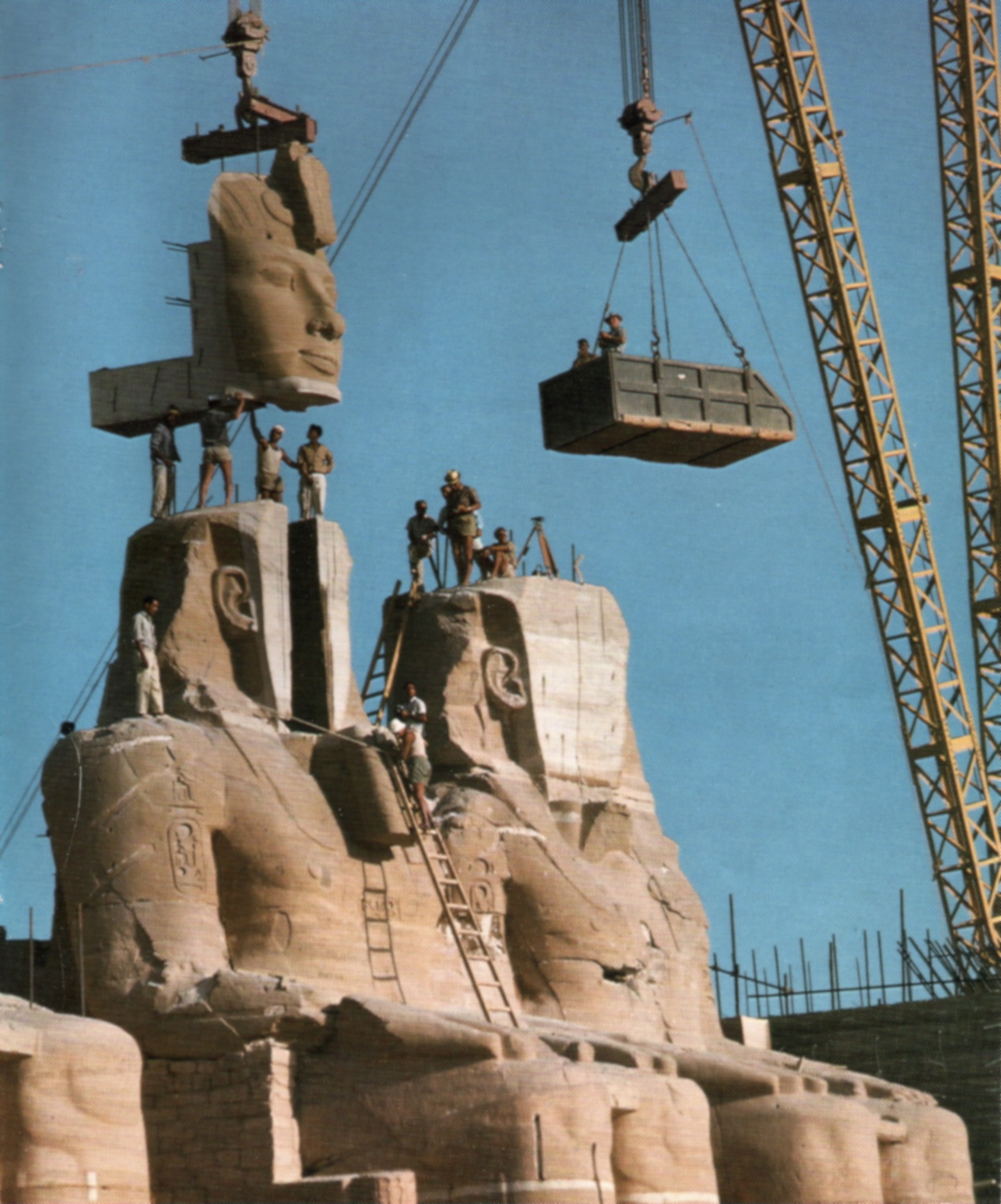
Shifting of Abu Simbel from Nile dam site

Critical Projects: Projects become critical when one or many of the four factors impact. So projects are hypothetically made critical by focusing or de-focusing on one or few of the aspects. A project in critical mode reveals its weak points or inferior sections. A project is considered as weak as its most inferior section, but the project achieves a strength equivalent to the average strengths of all its sections. Project management systems entail recognition of dependencies of the four aspects as risks and provide means for dealing (risk management) with them.

.

BERNARDO BELLOTTO

  BERNARDO BELLOTTO Post -376 SUNDAY Feature on ART of Architecture -by Gautam Shah BERNARDO BELLOTTO (1720-1780) was born in Venice (d...